Do I Need a Fiscal Representative in Portugal? (2026 Rules, Explained)
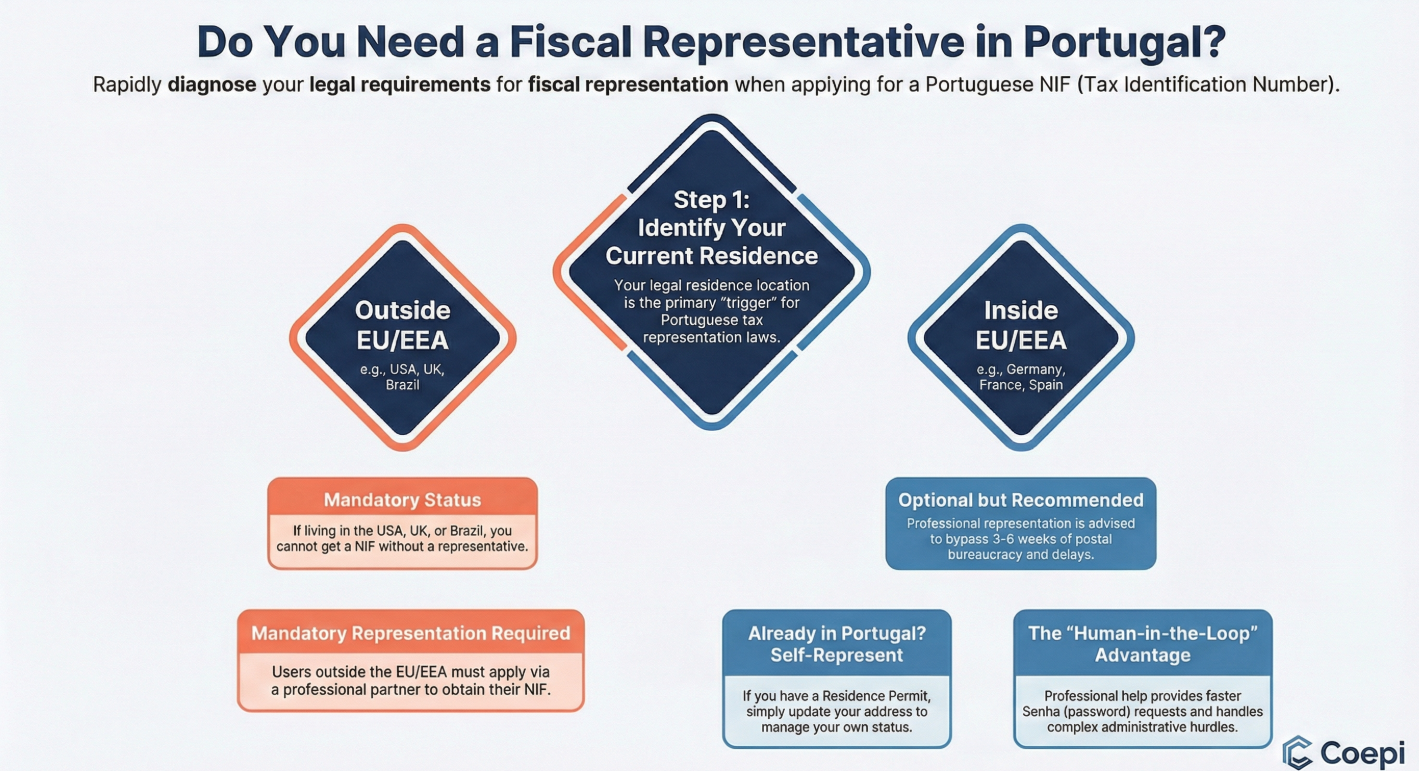
TL;DR: It depends on where you live and what you do in Portugal. Under Article 19(6) of the Lei Geral Tributária (LGT), taxpayers resident outside the EU/EEA who enter into a Portuguese tax relationship must appoint a fiscal representative resident in Portugal. But since Decreto-Lei 44/2022 of 8 July, the obligation disappears if you subscribe to electronic notifications on the Portal das Finanças — and per the Tax Authority's own guidance (Ofício Circulado 90057/2022), a non-EU resident with no Portuguese tax obligations does not need one at all, even at the moment a NIF is issued. EU/EEA residents never need one. As of August 2026, these rules are still in force.
What does Portuguese law actually say about fiscal representatives?
The baseline rule is Article 19(6) of the Lei Geral Tributária (LGT, approved by Decreto-Lei 398/98 of 17 December). It states that the following taxpayers must, for tax purposes, appoint a representative resident in Portuguese territory:
- taxpayers resident abroad;
- taxpayers resident in Portugal who leave the country for more than six months;
- companies and equivalent entities that cease activity.
Two qualifications matter and are often left out of online guides:
- Article 19(7) LGT: if you fall under this obligation and do not appoint a representative, you cannot exercise your rights before the tax administration — including filing a complaint (reclamação), an appeal (recurso) or a legal challenge (impugnação).
- Article 19(8) LGT: the obligation does not apply to taxpayers resident in, or moving to, an EU or EEA member state (for the EEA, provided the state is bound by tax administrative-cooperation rules equivalent to the EU's). For EU/EEA residents, appointing a representative is always optional.
So the requirement is real — but it is triggered by a tax relationship, not by the mere existence of a tax number, and it has never applied to EU/EEA residents.
What changed in 2022 with electronic notifications?
Decreto-Lei 44/2022 of 8 July amended Article 19 LGT and added two decisive paragraphs, in force since 9 July 2022:
- Article 19(15): the obligation to appoint a fiscal representative does not apply to taxpayers who subscribe to any of the dematerialised notification channels — the public electronic-notifications service linked to the single digital address (morada única digital), the electronic notifications and citations regime on the Portal das Finanças (notificações e citações eletrónicas), or the electronic mailbox (caixa postal eletrónica). The only carve-out is for companies and equivalent entities that cease activity.
- Article 19(16): for taxpayers resident outside the EU/EEA, cancelling an electronic-notifications subscription only takes effect after a fiscal representative has been appointed. You cannot quietly switch the channel off and drop below the radar.
The Portuguese government announced the change officially: non-residents outside the EU, Norway, Iceland and Liechtenstein who activate electronic notifications on the Portal das Finanças no longer need to appoint a fiscal representative.
In other words, as of August 2026, a non-EU/EEA resident has two ways to be compliant: appoint a representative, or subscribe to electronic notifications and actually monitor them. The exemption is not automatic — you must activate the channel in your reserved area under Notificações e Citações.
Who needs a fiscal representative in 2026?
| Your situation | Is a representative mandatory? | Legal basis |
|---|---|---|
| Resident in Portugal | No | Your Portuguese fiscal address is your point of contact (Art. 19(1) LGT). |
| Resident in the EU/EEA | No — always optional | Art. 19(8) LGT. |
| Resident outside the EU/EEA, no Portuguese tax obligations and no intention to exercise rights before the AT | No — per the AT's own interpretation | Ofício Circulado 90057/2022 (read with Art. 19(6) LGT and Decreto-Lei 14/2013). |
| Resident outside the EU/EEA, with a Portuguese tax relationship (property, vehicle, employment, etc.), subscribed to electronic notifications | No — exempt | Art. 19(15) LGT, added by Decreto-Lei 44/2022. |
| Resident outside the EU/EEA, with a Portuguese tax relationship, not subscribed to electronic notifications | Yes | Art. 19(6)–(7) LGT. |
| Resident outside the EU/EEA, self-employed in Portugal (VAT-registered activity) | Yes — the electronic-notifications exemption does not apply; a VAT representative is required | Ofício Circulado 90057/2022; Art. 30 VAT Code (CIVA). |
This table replaces the oversimplified "non-EU = mandatory" claim you will find in older guides — including, until now, this one. The precise answer is about tax relationships and notification channels, not nationality.
Do I need a fiscal representative to get a NIF?
Here is where sources genuinely contradict each other, so let's be precise.
What the Tax Authority says: Ofício Circulado 90057/2022 (20 July 2022, which revoked the earlier Ofício Circulado 90054) states explicitly that at the act of registration and attribution of a NIF to a non-resident with an address in a third (non-EU/EEA) country, appointing a fiscal representative is not mandatory (PDF copy of the ofício). The same ofício clarifies that a non-resident who has no tax obligations in Portugal and does not intend to exercise rights before the AT is not required to appoint one afterwards either.
What happens in practice: if you apply remotely from abroad, you generally cannot file the application yourself at a Finanças counter, and many online channels and individual tax offices still expect a Portugal-based representative to submit or accompany the request. This is why representative services exist: Coepi acts as your fiscal representative for the application, submits it through the official channels, and hands you the NIF plus your Portal das Finanças password.
What you can do afterwards: once you have your NIF and portal access, you can activate electronic notifications and — provided you meet the conditions above — cancel the fiscal representation entirely. Our step-by-step guide to that process is here: How to remove your fiscal representative using electronic notifications.
If you want to handle the process yourself, our DIY guide walks through the paperwork; if you'd rather have it done for you, you can get your Portuguese NIF online with Coepi acting as your representative.
Confused about the NIF process? We built a DIY Guide that will help you:

When does the requirement kick in after I have a NIF?
According to Ofício Circulado 90057/2022, a non-EU/EEA resident must appoint a representative — or subscribe to a dematerialised notification channel — when a tax legal relationship begins. The ofício lists the typical triggers:
- becoming the owner of a vehicle and/or property registered or located in Portugal;
- signing an employment contract in Portugal;
- carrying out a self-employed activity in Portugal.
The deadline to appoint a representative or activate electronic notifications is 15 days from the event that creates the tax relationship (Article 24(1) of Decreto-Lei 14/2013, as cited in the ofício). If you are starting a self-employed activity, the appointment must happen before the activity starts, and your representative must be a Portugal-resident VAT taxpayer (Articles 30(3) and 31(1) of the VAT Code).
What happens if I ignore the requirement?
Two consequences, both sourced:
- A fine (coima) of €75 to €7,500 for failing to appoint a representative when one is mandatory, under Article 124 of the Regime Geral das Infrações Tributárias (RGIT), as cited in Ofício Circulado 90057/2022.
- Loss of procedural rights: under Article 19(7) LGT, you cannot file complaints, appeals or legal challenges before the tax administration until a representative is in place.
Note that older articles citing a €50–€5,000 range are quoting an outdated version of the penalty provision.
What does a fiscal representative actually do — and not do?
Per Ofício Circulado 90057/2022, the representative ensures the non-resident:
- receives correspondence sent by the tax administration (the taxpayer is deemed domiciled at the representative's address, under Article 23(3) of Decreto-Lei 14/2013);
- complies with accessory tax duties, including filing income declarations;
- can exercise rights before the AT, including complaints, appeals and challenges.
Critically, the representative is not liable for paying your taxes — with one exception: if you carry out a VAT-taxable self-employed activity in Portugal, the VAT representative is jointly liable for the VAT debt (Article 30(5) CIVA).
This is also why the "just ask a friend" strategy is risky: if your friend moves, or forgets to forward a notification, the missed deadline and the fine are legally yours.

Can I remove a fiscal representative later?
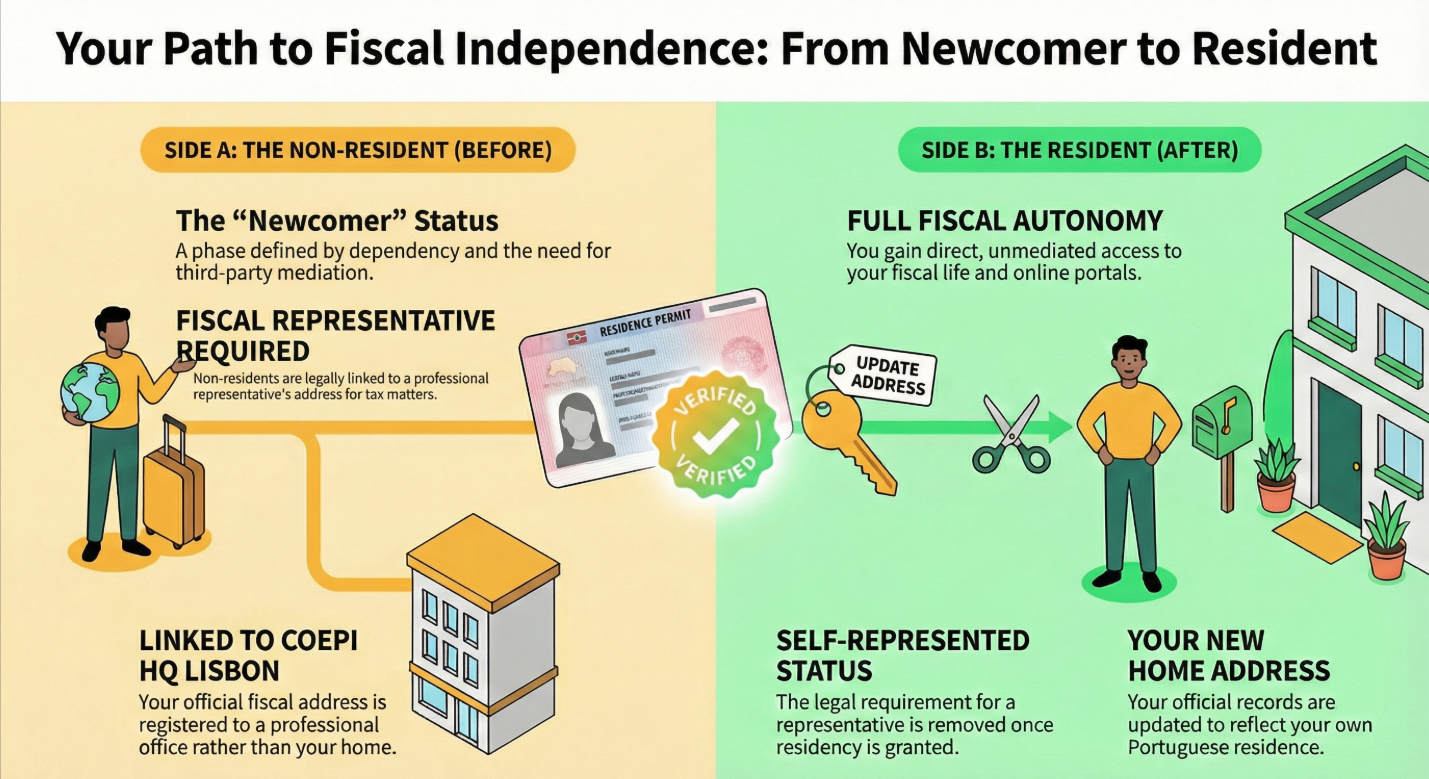
Yes — and since 2022 there are two routes:
- Move to Portugal. Once you register a Portuguese fiscal address, the non-resident representation rules no longer apply.
- Subscribe to electronic notifications. Activate notificações e citações eletrónicas (or the ViaCTT electronic mailbox) on the Portal das Finanças, then ask the AT to cancel the representation. The full procedure — including the e-balcão submission and the evidence PDF — is in our guide: How to remove your fiscal representative.
Two legal caveats from Article 19 LGT: under paragraph 16, if you live outside the EU/EEA, cancelling your electronic-notifications subscription only takes effect after a new representative is appointed — so the exemption dies the moment the channel does. And under paragraphs 9–10, a representative's resignation only becomes effective once the AT is notified and either one year has passed since the appointment or a new representative has been named (the AT then has 90 days to process the change).

Frequently Asked Questions (FAQs)
"Do I need a fiscal representative in Portugal if I live in the EU?"
No. Article 19(8) LGT makes representation optional for residents of EU and EEA member states (the EEA case requires equivalent administrative-cooperation rules, which Norway, Iceland and Liechtenstein meet). You may still appoint one voluntarily — for example to deal with language barriers — but the law does not require it.
"I live in Brazil / the US / the UK and only want a NIF. Do I need one?"
Not at the moment the NIF is issued, according to the AT's Ofício Circulado 90057/2022 — and not afterwards either, as long as you have no Portuguese tax obligations and don't need to exercise rights before the AT. In practice, applying remotely still usually goes through a Portugal-based representative (Coepi acts in that role for online NIF applications). If you later buy property, register a car, or work in Portugal, you must then either appoint a representative or activate electronic notifications within 15 days.
"Is the electronic-notifications exemption automatic?"
No. Article 19(15) LGT exempts only taxpayers who have adhered to one of the dematerialised channels. You must actively subscribe on the Portal das Finanças (A minha área → Notificações e Citações → Gerir canais) and keep monitoring it — an unread electronic notification is still a legally delivered notification.
"Does a fiscal representative pay my taxes if I don't?"
No, except for VAT. Ofício Circulado 90057/2022 confirms the representative is not responsible for the non-resident's tax payments; the sole exception is joint liability for VAT where the representative acts for a non-resident carrying out a VAT-taxable activity (Article 30(5) CIVA).
"What is the fine for not having a fiscal representative?"
€75 to €7,500 under Article 124 RGIT (as cited in Ofício Circulado 90057/2022), plus the suspension of your right to complain, appeal or challenge before the AT under Article 19(7) LGT.
Legal references verified as of August 2026: Article 19 of the Lei Geral Tributária (consolidated), Decreto-Lei 44/2022 of 8 July (Diário da República), AT Ofício Circulado 90057/2022 (PDF copy), and the Portuguese government's announcement. This article is information, not legal advice; tax law changes, so confirm the current text on the official sources before acting.
Coepi, the humans behind your first step.